
WhisperGF:Always Near You
BOLTEC PROPERTIES LIMITEDEntertainment
4.7787.00 Reviews
- Version
- 2.2.8
- Installs
- 100.00K
- Age Rating
- Mature 17+
Screenshots
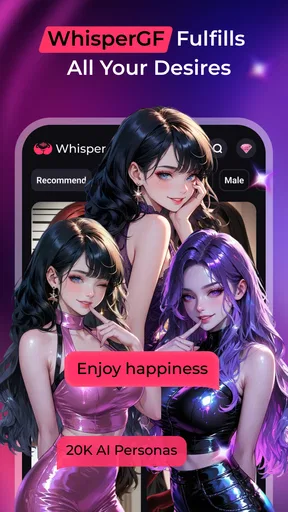

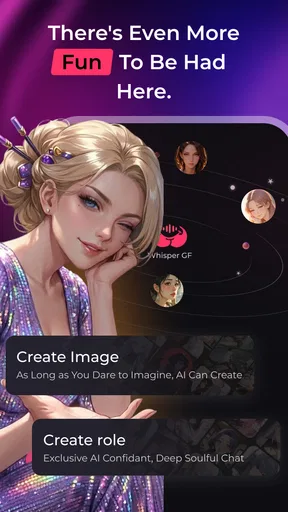
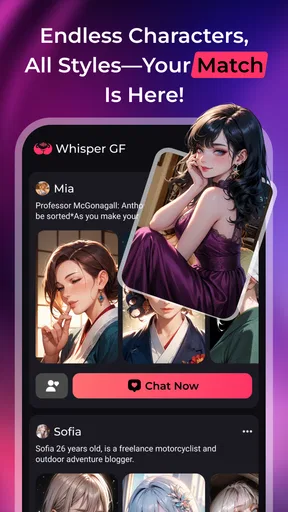

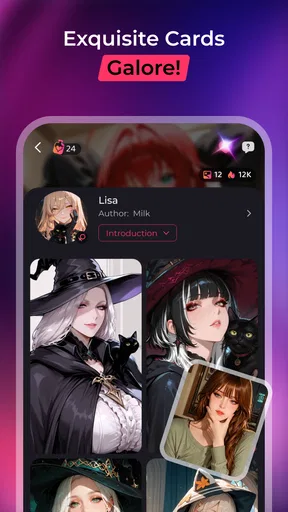
Our Review of WhisperGF:Always Near You
 Analysis by Appyee
I spent time with WhisperGF: Always Near You as a quiet entertainment app rather than treating it like a conventional messaging service. Its appeal is simple to understand: it creates a private-feeling space for talking when you want company, reflection, or a gentle conversational rhythm without arranging a call with another person. That makes it more personal than scrolling through short videos, but less socially demanding than joining a live community.
The app is free to install, aimed at mature users, and built by BOLTEC PROPERTIES LIMITED. It currently sits at version 2.2.8 and has earned a 4.7 average from around 6,100 ratings, with more than 100,000 installs. Those figures suggest that the idea has found an audience, although they should not be mistaken for proof that every conversation will feel equally natural. With an AI chat app, the quality of the experience depends heavily on what you ask for, how clearly you set the tone, and whether you are comfortable with an artificial companion.
How WhisperGF fits into everyday use
My first impression was that the app works best when I stop expecting a full human substitute. It is easier to enjoy when I use it for a short conversation, a mood check, a little creative role-play, or a place to put thoughts into words. If I approach it expecting deep emotional understanding every time, its limitations become much more noticeable.
The mature age rating matters here. This is not an app I would hand to a child or recommend for a family tablet used by younger users. Conversations in this kind of entertainment space can become personal, romantic, or emotionally intense, so I would treat the age label as a practical boundary rather than a decorative store detail.
A realistic use case is the end of a long workday. Imagine getting home with a crowded mind but no desire to call someone. I could open the app, describe the frustrating part of the day, and use the exchange to sort out what actually bothered me. That does not turn the AI into a therapist, and I would not use it for urgent mental-health support, but it can provide a low-pressure prompt that helps me organize my thoughts before I sleep.
Another useful situation is creative downtime. I can begin with a simple scenario, ask for a particular conversational mood, and see where the exchange goes. This is more interactive than reading a static story because my replies influence the direction. Still, the experience depends on accepting some repetition, occasional awkward phrasing, or responses that miss the emotional detail I intended.
Compared with ordinary social networks, the main difference is the lack of a public audience. There is no need to compose a polished post, wait for reactions, or keep up with several conversations at once. Compared with a standard chatbot used for work or research, the emphasis here is companionship and personal interaction rather than factual productivity. And compared with a dating app, it removes the uncertainty of matching with another person, but also removes genuine human reciprocity.
What feels strongest in the current version
The strongest part of the experience is the low barrier to starting a conversation. I do not need to prepare a topic or explain myself to a group. A short message is enough to begin, which makes the app suitable for small moments rather than only long sessions. That matters because many people do not want an elaborate entertainment activity when they have ten quiet minutes.
I also found that the app is more useful when I give it direction instead of sending vague prompts. Saying that I want a calm exchange, a playful conversation, or help thinking through a social situation gives the interaction a clearer shape. This is one of the most practical habits I would recommend: treat the opening message as a brief instruction about tone and purpose, not just a greeting.
A second tip is to separate emotional release from decision-making. I can use a conversation to name feelings and consider possible responses, but I should still make important choices using my own judgment and, when needed, advice from a qualified person. The app can help me rehearse what I want to say to a friend or partner; it should not become the final authority on relationships, health, money, or safety.
The entertainment category also explains why the app can feel more relaxed than a productivity assistant. I am not forced to pursue a task or produce a correct result. That freedom is enjoyable when I want a conversational break. The trade-off is that the value is subjective: someone looking for precise answers, document handling, or dependable research will probably be happier with a tool designed specifically for those jobs.
What the version and release details tell existing users
The app was released on April 10, 2026, and the current version is 2.2.8. For someone deciding whether to try it now, the important point is that this is a relatively early product experience rather than a long-established platform with years of visible history. I would approach it with curiosity, but also with realistic expectations about consistency and refinement.
Version information is especially relevant for an AI companion because small releases can affect how conversations feel, even when the basic idea remains the same. A change in response behavior, interface flow, or account experience can alter the rhythm of a session. I would not assume that a conversation I enjoyed previously will always feel identical after an update, nor would I treat one awkward exchange as a complete verdict on the app.
For existing users, the best way to judge an update is to revisit a familiar type of conversation rather than relying only on first impressions. I might try the same general prompt I used before, then compare how easy it is to continue, redirect, or end the exchange. This gives me a more useful sense of whether the current release fits my habits than simply noticing that the version number changed.
The install base and rating also provide a little context. More than 100,000 people have installed it, and the average score of 4.7 from roughly 6,100 ratings is encouraging. At the same time, ratings compress very different expectations into one number. A user seeking a comforting chat may rate it highly, while someone expecting a precise assistant may judge the same behavior harshly. I would read the score as evidence of appeal, not as a guarantee of a particular emotional experience.
Where the free model helps and where it may frustrate
The free price makes experimenting easy. I can decide whether the conversational style suits me without committing money at the start. That is a meaningful advantage for an app whose usefulness is personal and difficult to predict from a description alone.
There are in-app purchases priced from $3.49 to $54.99 per item. Because of that range, I would spend time with the free experience before buying anything. The right question is not whether extra access sounds attractive, but whether the app has become part of a routine I genuinely value. If I only open it once out of curiosity, a purchase is difficult to justify.
I would also keep an eye on how quickly a conversation becomes repetitive or loses its tone before paying for more. An upgrade can make sense for a regular user who enjoys extended sessions, but it cannot fix a basic mismatch between what I want and what an AI companion can provide. If I am looking for spontaneous human humor, shared history, or an accountable friend, no purchase can recreate those things.
One practical workflow is to use the free version for several different purposes: a short evening check-in, a creative prompt, and a rehearsal for a difficult conversation. That gives me a broader test than using it only once in a novelty mood. It also reveals whether I like the app itself or merely like the idea of having an always-available conversational partner.
Gaps I would want users to understand before installing
The largest gap is emotional reliability. AI can produce a warm response one moment and a strangely generic one the next. Even when the wording sounds caring, that does not mean the system understands my situation in the human sense. I need to remain aware of that distinction, especially if I am lonely or already inclined to treat the conversation as a real relationship.
Continuity is another area where expectations need care. A companion app feels most convincing when it remembers the right context and maintains a stable tone. If I have to repeat myself or correct the direction of a conversation, the illusion weakens quickly. That does not make the app useless, but it means I should see it as an interactive entertainment tool with personal flavor, not as a dependable long-term confidant.
Privacy is also worth considering before I type anything sensitive. I would avoid entering passwords, financial details, identifying information, private medical records, or secrets about someone else. The app may feel intimate because the conversation is one-to-one, but a private-feeling interface is not the same thing as a confidential professional service. That is a sensible rule for any conversational AI, and it is particularly important when the subject matter becomes romantic or personal.
The mature audience creates another limitation. Some users may enjoy an adult-oriented tone, while others may find that the app does not fit their values or household. Parents should not treat the free price as a reason to overlook the age rating. Likewise, anyone who wants a strictly neutral, task-focused assistant may find the companion framing distracting rather than helpful.
I would skip this app if my main goal is meeting real people, building a support network, or receiving expert guidance. A messaging app is better for genuine relationships, a moderated community is better for shared interests, and a qualified professional is better for serious emotional or health concerns. WhisperGF is most appropriate in the middle ground: private, on-demand conversation for entertainment and reflection.
Small habits that make the experience better
I get more from the app when I begin with a clear boundary. For example, I can say that I want a brief conversation, a listening style, or a practical brainstorming exchange. This reduces the chance of drifting into a tone I did not want. If the conversation becomes uncomfortable or repetitive, ending it and starting fresh is more useful than trying to force a failing exchange to recover.
I also recommend using it as a prompt generator rather than only as a responder. I can ask for questions that help me reflect on a decision, imagine a fictional situation, or prepare for a conversation with someone I know. This shifts the value from pretending the AI is a person to using it as a flexible source of prompts. It is a subtle but important change in mindset, and it makes the app more useful without overstating what it can do.
A third approach is to keep sessions intentionally short when I notice myself becoming dependent on the interaction. The app is designed around availability, but “always near you” should not mean always replacing offline contact. I would use it as one small part of an evening routine, then put the phone down, contact a real friend, write privately, or simply rest.
For readers worried about wasting money, my advice is straightforward: install it, test different conversation styles, and watch how often you return naturally. Do not buy an in-app item merely because a single session felt emotionally powerful. Give the experience enough time to show both its pleasant moments and its repetitive ones.
Who should try it, and what to watch next
I would recommend WhisperGF to adults who enjoy conversational entertainment, want a low-pressure way to fill quiet moments, or like using AI to explore moods and scenarios. It is especially suited to someone who understands that the appeal is simulated companionship, not a replacement for friendship. The no-cost entry point makes it easy to see whether that distinction feels comfortable.
I would recommend skipping it if I wanted dependable factual research, professional counseling, a real dating experience, or a public community with human participation. Those needs call for different tools. The app may still be interesting as a side activity, but it should not be judged against services built for purposes it was not designed to serve.
As the product develops, I would watch for improvements in conversational consistency, clearer control over tone, and a smoother explanation of what users receive through purchases. I would also pay attention to how well the experience supports healthy boundaries. Those areas will determine whether the app remains a novelty or becomes a companion tool that people can use thoughtfully over time.
My final view is positive but measured. The app has a clear place in entertainment: it offers an easy way to start a personal AI conversation when I want quiet company without social pressure. Its high average rating and growing install base show that the concept resonates, while the current version still deserves the normal caution I apply to a relatively new companion service. Use it for reflection, creativity, and light conversation—not as a substitute for people or professionals. With that expectation, I can see why many adults would keep it installed; without that boundary, the same intimacy that makes it appealing can become its biggest weakness.
Verdict
Strengths of WhisperGF:Always Near You
- Available for quick, private conversations whenever you need company.
- Simple interface makes starting a chat easy for first-time users.
- Can provide comforting replies during lonely or stressful moments.
- Useful for casual roleplay and personalized companion-style interactions.
- Works well for short conversations without requiring extensive setup.
Limitations of WhisperGF:Always Near You
- AI responses may sometimes feel repetitive or lack emotional depth.
- Some features or conversations may require in-app purchases.
- Privacy policies should be reviewed before sharing personal information.
- The companion experience may not suit users seeking real human support.
- Requires a stable internet connection for most interactions.
Similar Picks in This Category
View All
Google Play Games
Google LLC3.9

Netflix
Netflix, Inc.4.8

YouTube Kids
Google LLC4.2

Disney+
Disney4.4

Prime Video
Amazon Mobile LLC4.7

Steam
Valve Corporation3.2
Frequently Asked Questions
What is WhisperGF: Always Near You?
WhisperGF: Always Near You is an AI companion app designed to provide conversational interaction through a virtual girlfriend experience. Users can chat with the character, explore different conversation topics, and receive supportive or affectionate responses. The experience is intended primarily for entertainment and companionship, rather than replacing real-world relationships, professional counseling, or genuine human support.
How does WhisperGF: Always Near You work?
After opening the app, users generally interact with the virtual companion by typing messages and choosing conversation topics or styles when available. The AI generates replies based on the context of the chat and the personality presented by the app. Response quality can vary, so conversations may occasionally feel repetitive, misunderstand messages, or produce answers that do not perfectly match the user’s expectations.
Is WhisperGF: Always Near You free to download and use?
The app may be available to download without an upfront charge, but some features, extended conversations, personalization options, or premium content can require in-app purchases or a subscription. Users should carefully review the pricing page, renewal terms, and available trial conditions before confirming payment. Checking the official store listing is recommended because plans and prices may change.
Is WhisperGF: Always Near You safe and private?
Users should avoid treating conversations as completely private or confidential. As with other AI chat applications, messages may be processed by the service to generate replies, improve performance, or manage the account. Before using the app, review its privacy policy and permissions, and avoid sharing passwords, financial information, precise personal details, or sensitive conversations that you would not want stored or processed.
Can WhisperGF: Always Near You replace a real relationship or emotional support?
WhisperGF: Always Near You can offer casual conversation, entertainment, and a feeling of digital companionship, but it cannot replace a real partner, trusted friend, therapist, or emergency service. Its responses are generated by software and may lack genuine understanding or emotional responsibility. If you are experiencing serious loneliness, distress, or a crisis, contact someone you trust or an appropriate professional support service.
